Ringo Bushi
Popular shin-min’yō song from Aomori for shamisen.
This is what you’ll get:
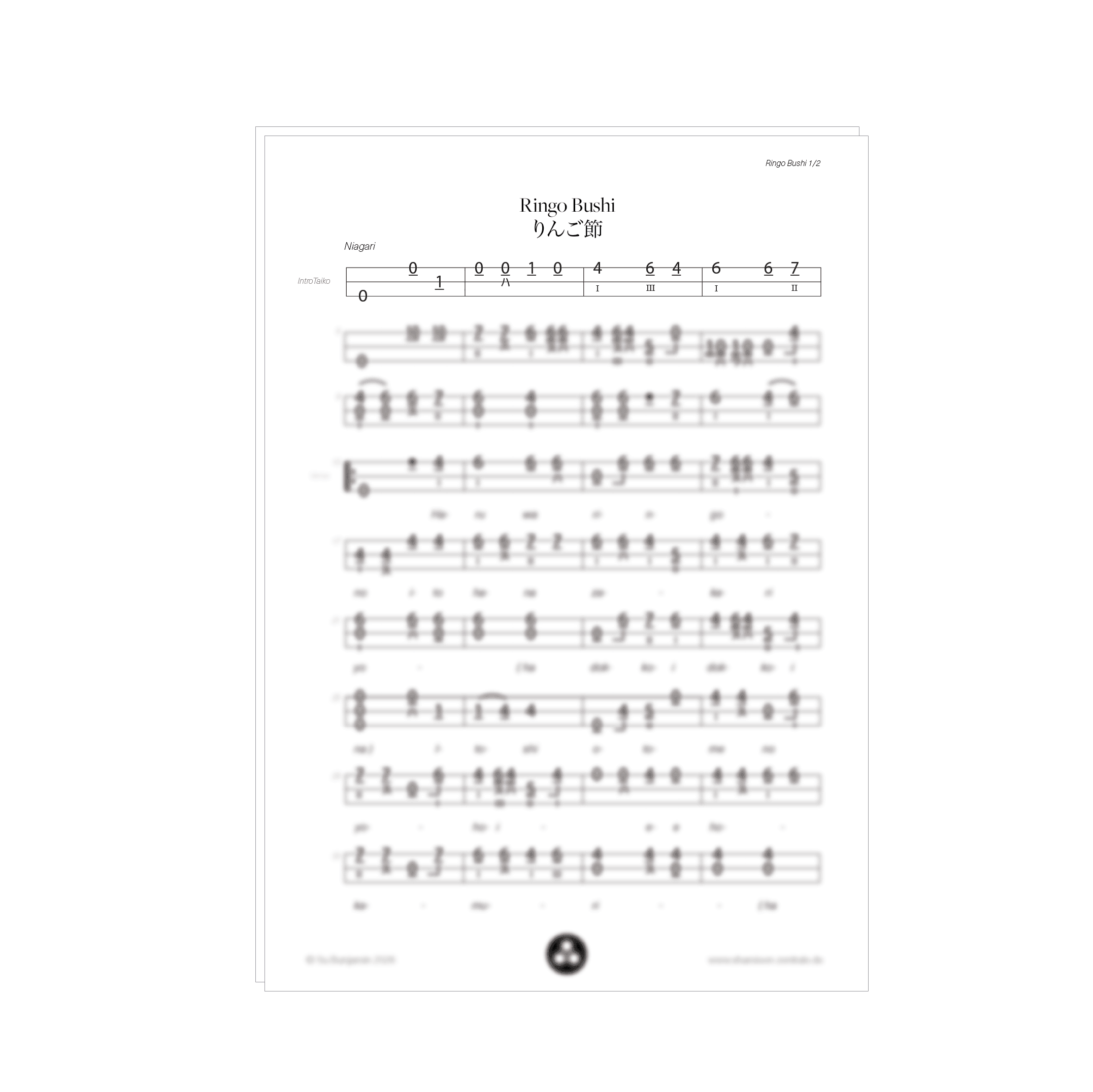
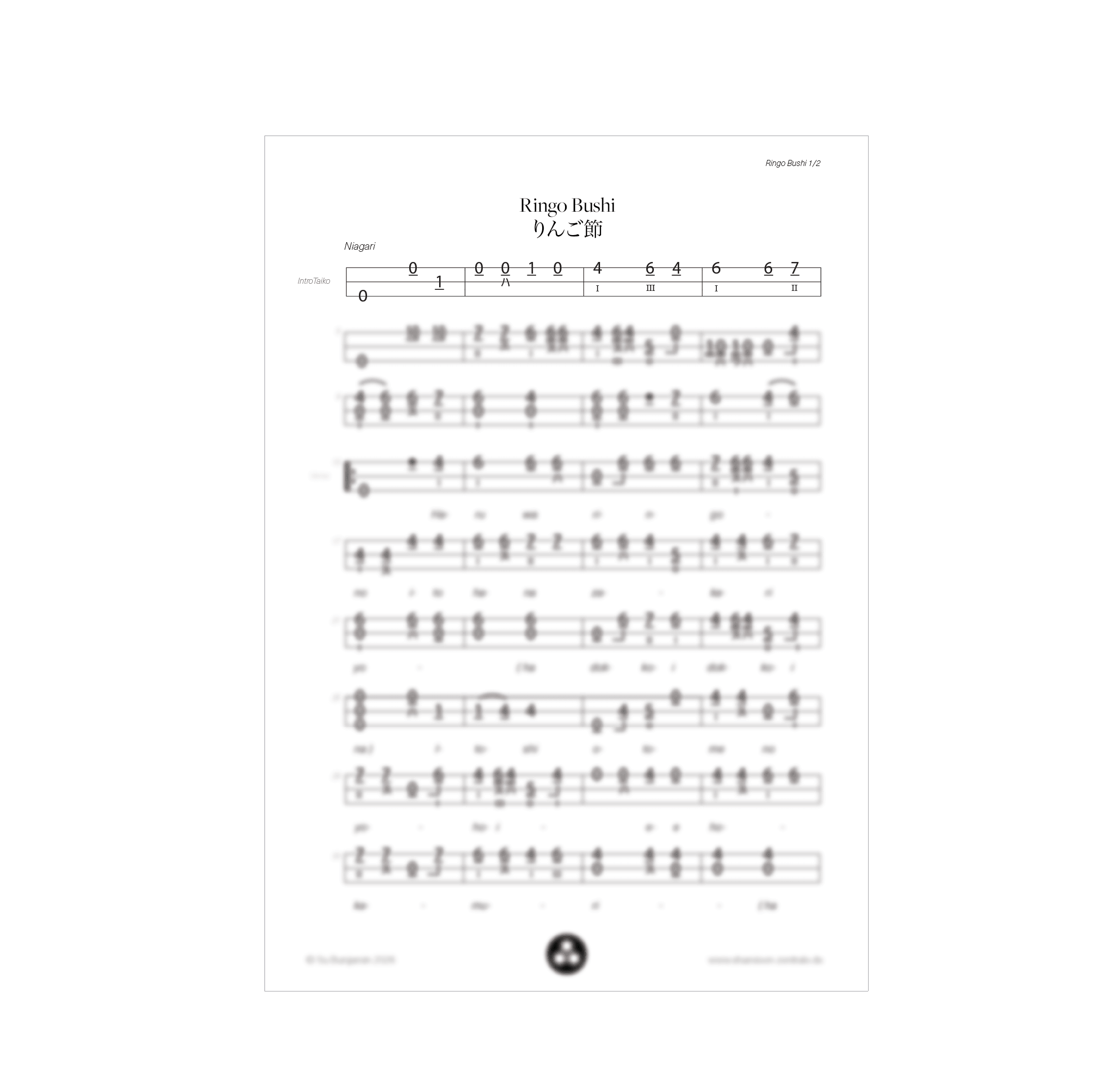
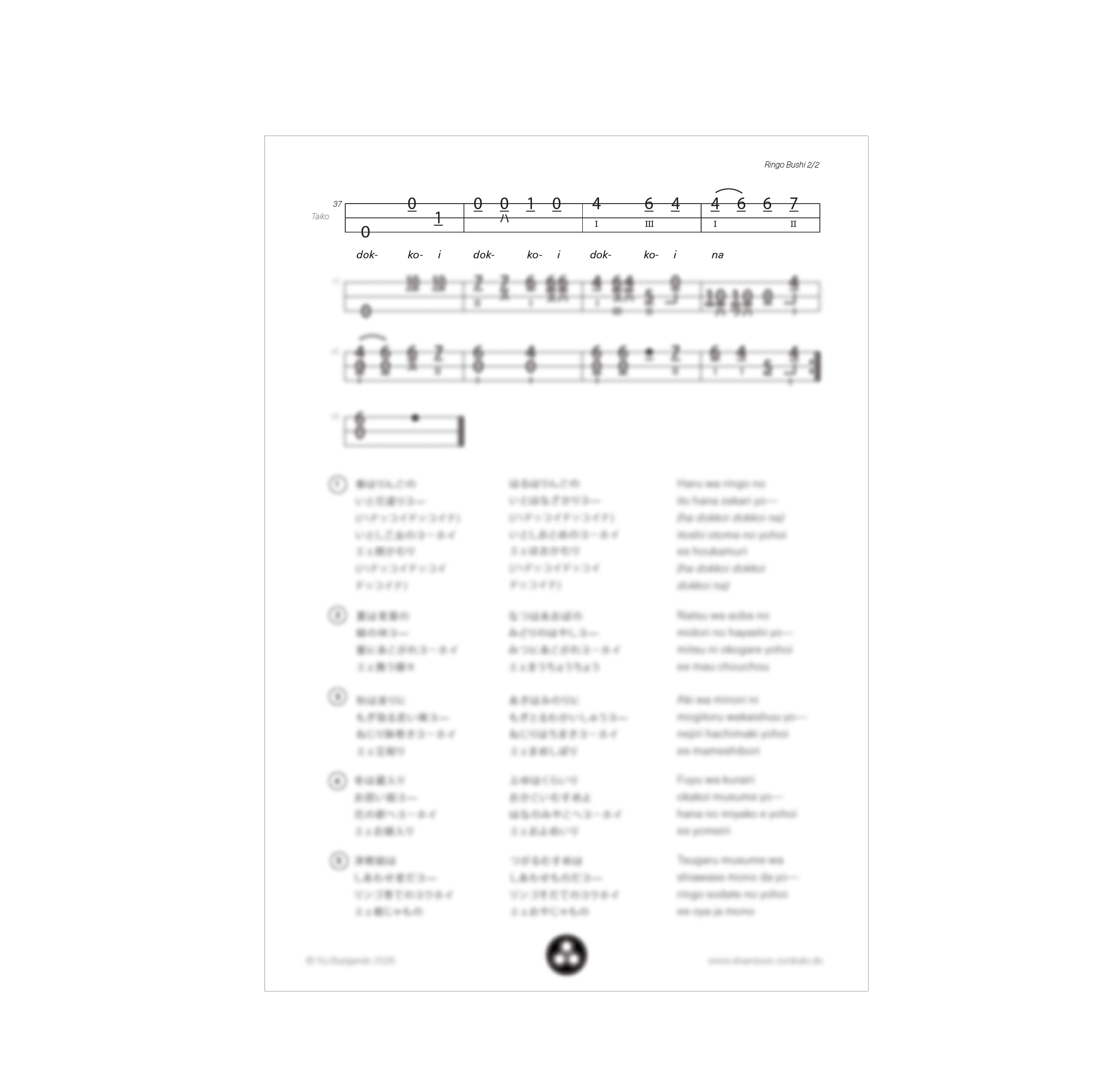
- 1 pdf with 2 pages total (including lyrics)
- 4 mp3 play along files
Song specifications:
- advanced beginner to intermediate level
- niagari tuning (C-F-C)
- techniques: upstroke (sukui), pull-offs (hajiki), sukui-hajiki combos, slides (suri), oshibachi, strums
2,95 €
Details
Get the notation for the popular Japanese Folk Song Ringo Bushi plus super useful play along files to help you learn and practice the song! You can download the files from your customer account page after the purchase – a link will be provided in the order confirmation e-mail.
The notation includes the song lyrics with all the verses in kanji, hiragana, and romaji to give you the complete package for the song. The singing melody is almost the same as the shamisen melody for this song. I recommend listening to different recordings to see what kind of singing you like most. The text in brackets is the so-called “kakegoe” – that’s a kind of chant that is usually spoken by participants other than the singer.
The mp3 play along files come in four different speed versions: 55 bpm, 80 bpm, 90 bpm, and 110 bpm.
Have a short listen to see if you like the tune! Here’s the beginning of Ringo Bushi:
About the song:
Ringo Bushi is a so-called shin-min’yō (“new folk song”). Unlike traditional folk songs with a much older history, shin-min’yō were composed and popularized during the early 20th century. Ringo Bushi dates back to the 1920s and celebrates life in Aomori Prefecture – Japan’s most famous apple-growing region.
The notation is written out for shamisen in bunkafu (tablature) notation and includes the song lyrics. Having the lyrics available can be helpful for understanding the phrasing and overall structure of the melody. It is also a lot of fun to listen to different sung versions of the song and follow along with the notation.
As with every folk song, there are many different versions of Ringo Bushi in circulation. The details vary from one arrangement to another, but they all follow the same underlying melody. This version includes a number of characteristic ornamentations and techniques that give the piece its lively character.
While I consider Ringo Bushi suitable for advanced beginners, it contains more techniques than many beginner songs. If you already feel comfortable with basics such as sukui, oshibachi, and hajiki, this piece is a great opportunity to practice combining them in a musical context.
The ornamentations are what make the melody particularly charming, but don’t feel obliged to play every single one perfectly from the beginning. You can always simplify passages, focus on the main melody first, and gradually add the details later.
A General Note on Tuning:
In every tuning, the strings are tuned in a certain relation to each other. For folk songs, there’s no fixed rigid tuning to a definite pitch (in contrast, the A-string on the violin is always tuned to 440 or 442hz) but what’s most important is how the strings are tuned in relation to each other.
A good rule of thumb is to tune your instrument over the base of C. This means, the big string will be tuned to C and the other strings according to the tuning of the song:
Honchōshi: C-F-C
Niagari: C-G-C
Sansagari: C-F-Bb
Access to the pdf and mp3:
Please note that this item is downloadable once only – just as receiving a physical copy of the scores would be. Consider it a “direct delivery” 🙂
After the purchase, you can download the file from your account page under “downloads” or via the link in your order confirmation email.
Make sure you save your file in an easy to locate directory. Please don’t hesitate to contact us via email if you need further assistance.